A year or two shy of his bossa nova success, Stan Getz set his mind to improvising against a backdrop of darkish yet scintillating string charts. The orchestral muscle was provided by arranger Eddie Sauter; the heady and fluid horn lines, of course, came from Getz. The jazz star might have been all airy samba fog to some, but on this classic date he really showed his expansive horn talents: whether leaping and yelping on such galvanizing sides as "I'm Late, I'm Late" or ingeniously responding to the many shades heard in a grand ballad like "I Remember When," Getz is never short on ideas or panache. Admittedly Getz's most challenging date and arguably his finest moment, Focus roams the vast jazz landscape outside of bop and boogaloo to fabulous and memorable effect.
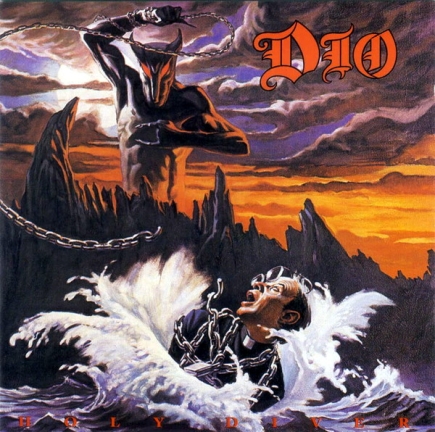
After playing a major role in five positively classic heavy metal albums of the late '70s and early '80s (three with Ritchie Blackmore's Rainbow and two with Black Sabbath), it seemed that singer Ronnie James Dio could truly do no wrong. So it wasn't all that surprising -- impressive, but not surprising -- when he struck gold yet again when launching his solo vehicle, Dio, via 1983's terrific Holy Diver album. Much like those two, hallowed Sabbath LPs, Heaven and Hell and Mob Rules, Holy Diver opened at full metallic throttle with the frenetic "Stand Up and Shout," before settling into a dark, deliberate, and hypnotic groove for the timelessly epic title track -- a worthy successor to glorious triumphs past like Rainbow's "Stargazer" and the Sabs' "Sign of the Southern Cross." But subsequent metal anthems like "Straight Through the Heart," "Invisible," and the lycanthrope lullaby "Shame on the Night" were no less inspired; and by injecting uncommonly catchy melodies into the heavy rock riffery still dominating more accessible numbers such as "Gypsy," "Caught in the Middle," and hit single "Rainbow in the Dark" (where the singer himself played rather spotty keyboards), Dio proved himself perfectly capable of competing with the increasingly commercial hard rock fashions soon to come. Although most fans would agree that Dio would arguably never again replicate the simply sublime symbiosis of beauty and brawn achieved by the all-time standout "Don't Talk to Strangers." And, to be fair, aside from Ronnie's unquestionably stellar songwriting, Holy Diver's stunning quality and consistency owed much to his carefully chosen bandmates, including powerhouse drummer (and fellow Sabbath survivor) Vinny Apprice, veteran bassist Jimmy Bain, and a phenomenal find in young Irish guitarist Vivian Campbell, whose tastefully pyrotechnic leads helped make this the definitive Dio lineup. So, too, is Holy Diver still the undisputed highlight of Dio's career, and, indeed, one of the finest pure heavy metal albums of the 1980s.
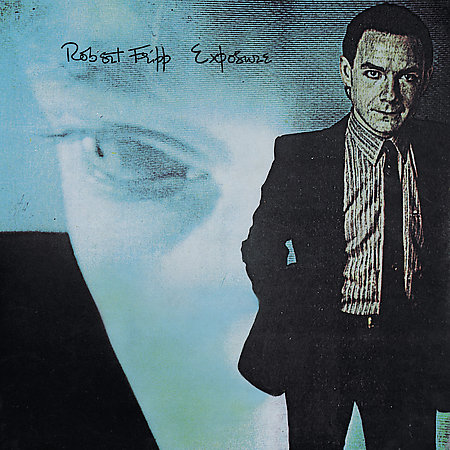
Conceived as the third part of an MOR trilogy that included Peter Gabriel's second album and Daryl Hall's Sacred Songs, Exposure is concerned with a marketplace that Fripp saw as hostile to experimentation and hungry for product. Strangely, then, Exposure is one of his most varied and successful rock albums, offering a broad selection of styles. "Water Music I and II" is pure Frippertronics; "Disengage" and "I May Not Have Had Enough of Me But I've Had Enough of You" are angular, jagged rock like he would make with the reformed King Crimson; "North Star" is a soulful ballad led by Daryl Hall on vocals, and a less bombastic version of "Here Comes the Flood" with Peter Gabriel singing makes a melancholic ending. Peter Hammill, Terre Roche, and Narada Michael Walden also add vocals to a pleasant experiment in pop, Fripp style.
By 1983, with the new romantic movement they'd sprung from a rapidly fading memory, the members of Spandau Ballet showed they had no intention of traveling the same path. Always ambitious, the British quintet really got down to business: Gone were the kilts, frilly shirts, and makeup — as well as the sometimes chilly electronics of their first two albums. Instead, after recording at Compass Point Studios in the sun-soaked Bahamas, the group turned up in smartly tailored suits, with a sleek and mainstream sound to match. That came courtesy of producers Steve Jolley and Tony Swain, who gave Spandau the sort of pop-R&B sheen that had produced hits for clients like Imagination. And it also reflected the growing skill of guitarist Gary Kemp, the band's primary songwriter, who crafted a set of tunes aimed squarely at the charts. The one that succeeded most spectacularly, of course, was the title cut, a glossily-updated Motown-style ballad that became one of the decade's biggest hits — aided by a video that cast singer Tony Hadley as a young Frank Sinatra, crooning about the sound of his soul. But Kemp had more arrows in his quiver, as well; the catchy soft disco of "Communication" and "Lifeline" coyly suggests, rather than demands, listeners' presence on the dancefloor, while the suave, spy flick-inspired "Gold" finally gives Hadley an appropriately rich setting for his dramatic warble. Some listeners at the time called the album an MOR sellout, but its slick surfaces remain tough to resist, and while none of the cuts generate the excitement of past singles like "To Cut a Long Story Short" or "Chant No. 1," True remains Spandau Ballet's most consistent and best all-around album.
Film director Alfonso Cuarón's dystopian science fiction thriller Children of Men is about a near future in which human fertility has nearly ceased, and to represent a setting that is familiar yet disturbing, the compilers of this various-artists soundtrack (there is also an album of the score) have chosen some rock and pop songs by well-known artists dating back to the '60s, some of them, however, presented in versions not so well known. Everybody knows the heavy metal band Deep Purple, but the band's initial American hit, a cover of Joe South's "Hush," doesn't sound much like its more successful "Smoke on the Water" phase. The Beatles' "Tomorrow Never Knows" and the Rolling Stones' "Ruby Tuesday" are iconic '60s songs, but they are here performed by Junior Parker and heavily accented Italian singer Franco Battiato, respectively. John Lennon's "Bring on the Lucie (Freeda Peeple)," a song featured on his 1973 album Mind Games, is not one of his more celebrated numbers, despite its anthemic appeal; the version heard here is a rehearsal take that first appeared on the Lennon Anthology box set in 1998. There are also rap and reggae toasting tracks, and some electronic music, adding to the sense of dislocation called for in the film. Cuarón, whose previous film was Harry Potter and the Prisoner of Azkaban (though his first major release, the provocative Y Tu Mamá También is more typical of his style), ends with the same voice that accompanied the credits to that film's successor, Harry Potter and the Goblet of Fire, that of former Pulp frontman Jarvis Cocker. This time, however, Cocker has a far more troubling message. His lyrics to "Running the World," drawn from his 2006 debut solo album Jarvis, justify this collection's "Parental Advisory/Explicit Content" sticker, particularly in the chorus, with its use of the plural of a four-letter word for female genitalia (a word considered far more vulgar in the U.S. than in the U.K., for some reason) as a characterization of those who are "still running the world." If that's also the point of Children of Men, then its ending can't be too happy.
In 1927, two remarkable people arrived in the United States after lengthy and successful tours of Europe: Lev Sergeivitch Termen (anglicized to Leon Theremin) and Clara Rockmore (whose maiden name was Clara Reisenberg). Theremin was a young Russian physicist who was demonstrating a new musical instrument that he invented. The instrument was played by the motion of the musician's hands in the space surrounding the instrument. Clara Rockmore, a professional violinist from the age of 9, became aware of the musical potential of Theremin's invention. She spent several years collaborating with Theremin during which time he developed his invention into a sensitive, wide-range musical instrument. Clara subsequently embarked on a performance career that encompassed well over a hundred concerts, including appearances with major symphony orchestras, and set the definitive standard for theremin performance technique.
To play the theremin, the performer stands in front of the instrument, a little left of center. The feet are spread slightly to keep the body as motionless as possible. To determine the pitch of the instrument's tone, the player varies the distance between her right hand and the pitch antenna. When the instrument is properly tuned, the pitch goes from lower than two octaves below middle C when the player's right hand is back at her shoulder, to approximately 2 1/2 octaves above middle C when the player's hand barely touches the pitch antenna. To determine the loudness of the instrument's tone, the player varies the distance between her left hand and the middle of the volume antenna. Maximum loudness occurs when the hand is removed from the antenna; complete silence occurs when the hand is an inch or so from the loop.
The thereminist must move her hands with incredible precision as well as speed if she wishes to play distinct notes with correct intonation. Ms. Rockmore actually uses fingering patterns to play the most rapid passages. For instance, if she were to play an upward arpeggio, she would start on the lowest note with right hand tilted back and fingers withdrawn. To play the next note she would abruptly move her hand forward from the wrist, while keeping her right arm motionless. The third note would be played by rapidly extending the little finger, and the fourth note by extending one or two more fingers while simultaneously turning the wrist sideways to bring the newly-extended fingers nearer to the pitch antenna. She would then continue the arpeggio by moving her whole arm closer to the pitch antenna while drawing her hand and fingers back, then repeating the above-described succession of movements. At the same time, she may articulate each individual pitch by rapidly shooting the fingers of her left hand into the volume antenna loop, then withdrawing them, to silence the tone during the very short periods of time that her right hand moves from one pitch to another. No other theremin player has ever mastered this difficult and intricate technique for playing rapid successions of precise pitches - "aerial fingering" as one reviewer termed it.
Stevie Wonder was beginning to rebel against the Motown hit factory mentality in the early '70s. While he certainly hadn't lost his commercial touch, Wonder was anxious to address social concerns, experiment with electronics, and not be restricted by radio and marketplace considerations. Still, he gave the label another definitive smash with the title track, while sneaking in a cover of the Beatles' "We Can Work It Out" and penning more intriguing tunes like "I Can't Let My Heaven Walk Away" and "Never Had a Dream Come True."
Boasting one of the most thinly veiled references to smoking pot this side of British act Leaf Hound, Primevil's only album, Smokin' Bats at Campton's (Dave Campton being their lead singer; "bats" being, well, you know), was originally recorded in 1974, but only found its way onto CD some 20 years later. Now, the record is frequently cited as a bona fide stoner rock touchstone (whether anyone could find a copy to be influenced by or not, in the interim), and its eight cuts run a wide gamut featuring surprisingly refined songcraft and impressive musicianship, as well as semi-improvised efforts and unfocused jam waffling. The best qualities among these are all exemplified within the opening trio set off by the standout "Leavin'," with its acoustic passages and stop-start riffs, the hard-driving "Progress," with its funky bass, wailing harp and twin guitar midsection, and the instrumental six-string showcase "Fantasies," which recalls Fly by Night-era Rush, but was in fact recorded one year earlier. On the other hand, forgettable rockers like "Pretty Woman" and "Tell Me If You Can" don't fare nearly as well, stumbling on some truly awful lyrics from Campton amid their boring, sub-Cactus-like thud. Likewise, the white-knuckled romp, "Hey Lover," was allegedly whipped together in one night -- and sounds like it, but at least it possesses a certain rough charm à la Sir Lord Baltimore. Back on firmer ground, the memorable "High Steppin' Stomper" actually shows traces of glam rock (must be that hand-clapping and boot-stomping), but then the closing "Your Blues" screws it up again by offering nothing but -- you guessed it -- lazy blues jams, serving no foreseeable purpose aside from framing some searing lead guitar flights, and acting as album filler. Even with all of these inconsistencies, though, Smokin' Bats at Campton's is a true relic that's still well worth excavating by stoner rock enthusiasts, who are bound to enjoy its sporadic triumphs as much as they'll be captivated by its modest D.I.Y. origins.
Welcome. Just a few things: first off, you are strongly encouraged to purchase the music on the site, hence the links to Amazon.com and other retailers. Also, none of the links on the site are to files I personally uploaded. However, if you would like me to remove any, let me know. The files are either .rar or .zip and don't all come from the same file hosting provider. Comments are welcome. Thanks for visiting!
Oh, and yeah, I totally ripped off Zamboni Soundtracks' theme, concept, and format. Dude does it right and has one of the best music blogs out there, so why wouldn't I?
 A year or two shy of his bossa nova success, Stan Getz set his mind to improvising against a backdrop of darkish yet scintillating string charts. The orchestral muscle was provided by arranger Eddie Sauter; the heady and fluid horn lines, of course, came from Getz. The jazz star might have been all airy samba fog to some, but on this classic date he really showed his expansive horn talents: whether leaping and yelping on such galvanizing sides as "I'm Late, I'm Late" or ingeniously responding to the many shades heard in a grand ballad like "I Remember When," Getz is never short on ideas or panache. Admittedly Getz's most challenging date and arguably his finest moment, Focus roams the vast jazz landscape outside of bop and boogaloo to fabulous and memorable effect.